
PILEA PEPEROMIOIDES CARE: EASY GUIDE TO GROWING THE CHINESE MONEY PLANT
Updated: Jan 29
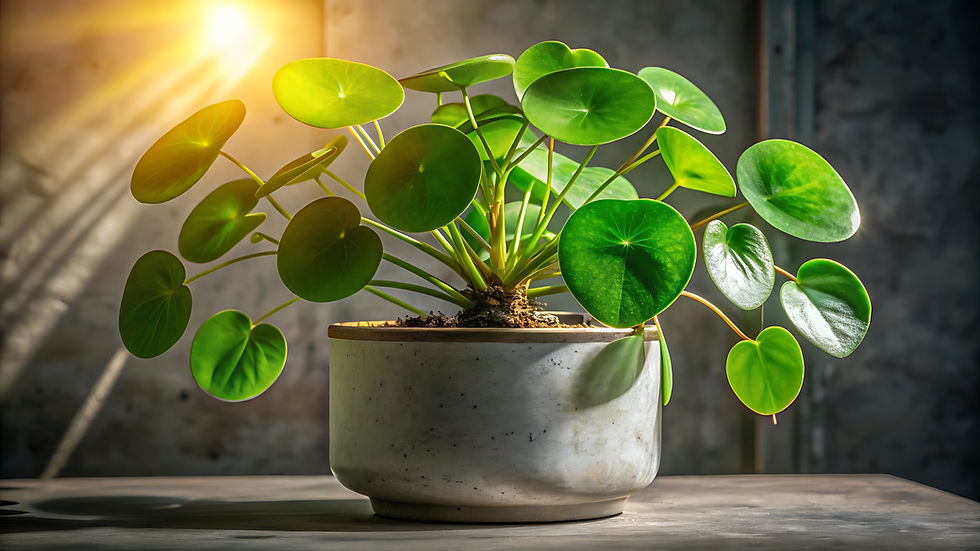
Money doesn’t grow on trees — at least not literally.Enter the Pilea peperomioides, commonly known as the Chinese Money Plant. With its perfectly round, coin-shaped leaves and its reputation for bringing good fortune, abundance, and optimism, this charming plant has rightfully earned its place in homes across the world. Its striking appearance, ease of care, and prolific nature make it an ideal plant for gifting and sharing.
Known also as the pancake plant, coin plant, or friendship plant, the Chinese Money Plant is an easy-to-grow houseplant and is increasingly available at nurseries and plant stores. Its bright green leaves grow on slender stems that radiate from a single central trunk, reaching about 12 inches in height. Because it stores water, it is considered a perennial evergreen succulent.
ORIGIN
Native to the Yunnan Province of southern China, the Chinese Money Plant thrived for centuries at the foothills of the Himalayas. In 1978, a specimen was sent to London’s Kew Gardens, where botanist Wessel Marais uncovered a record referencing the plant as early as 1912.Despite its early documentation, it remained obscure for decades.
In 1946, missionary Agnar Espergren brought samples to Norway, where it quickly gained popularity as a houseplant. Because it reproduces easily, it was frequently passed among friends—eventually traveling across Europe and, later, the world.
CARE, POTENTIAL PROBLEMS AND CURES
Soil – Use well-draining potting soil with a pH between 6.0 and 7.0. A variety of devices can measure pH, light, and moisture levels, but the Pantry Method is an easy DIY test:
To test alkalinity: Add ½ cup of vinegar to 2 tablespoons of soil. If it fizzes, the soil is too alkaline.
To test acidity: Moisten 2 tablespoons of soil, then add ½ cup of baking soda. If it fizzes, the soil is too acidic.
Light – Chinese Money Plants thrive in bright to medium, indirect light. In lower light, they become leggy as they stretch toward the sun. Rotating the plant weekly helps maintain an even, symmetrical appearance.
Water – Water only when the soil feels dry to the touch. Overwatering is the most common issue and causes leaves to yellow and drop. Keep soil lightly moist, never soggy.
Temperature – Pilea prefers average indoor temperatures and should be kept away from cold drafts. While resilient, it does not tolerate frost.
Fertilizing – Feed every three weeks during spring and summer using a diluted, balanced fertilizer. Reduce feeding during fall and winter to every six to eight weeks, as the plant enters a natural dormancy.
Pests and Diseases – Chinese Money Plants are typically healthy but can attract fungus gnats, spider mites, mealybugs, and scale. Treat early signs by rinsing the plant or using insecticidal soap or neem oil.
PROPAGATION
Often referred to as the “friendship plant,” Pilea peperomioides is famous for its generosity. It produces off shoots (suckers) beneath the soil and can also be propagated from stem cuttings.
Propagation from Clippings
Use clean, sharp shears to cut the stem where it meets the trunk. Place the cutting in a small vessel of water, submerging the base. Roots typically appear in 2–3 weeks. Once established, transfer to potting mix.
Propagation from Suckers
Score a circle around the base of the baby plant, about 1–2 inches deep. Gently lift the sucker, maintaining the root system. Plant it in a small pot filled with fresh potting mix. Create a hole about the width and depth of your pinky finger, insert the roots, lightly cover with soil, and water gently.Place in bright, indirect light — and watch it thrive.
FUN FACTS
In feng shui, the Chinese Money Plant is associated with wealth, health, and positive energy.
Feng Shui Placement
Southeast corner: best for attracting prosperity.
East side of home or room: ideal for improved wellbeing.
Avoid placing the plant near bathrooms, where beneficial energy is believed to drain away.
Often given as a symbol of friendship due to its prolific nature.
KEY TAKEAWAYS
The Chinese Money Plant is an easy-to-grow, visually distinct houseplant with a rich history and a symbolic connection to prosperity and positivity. It is moderately fast-growing, low-maintenance, and highly adaptable. With proper care, bright indirect light, and occasional fertilizing, this charming plant will reward you with abundant new growth — and plenty of baby plants to share.
SOURCES
Wikipedia
ABC Gardening Australia
The Spruce
The Sill
The Old Farmer’s Almanac
Amazon
by MG Angela Fonner

Comments